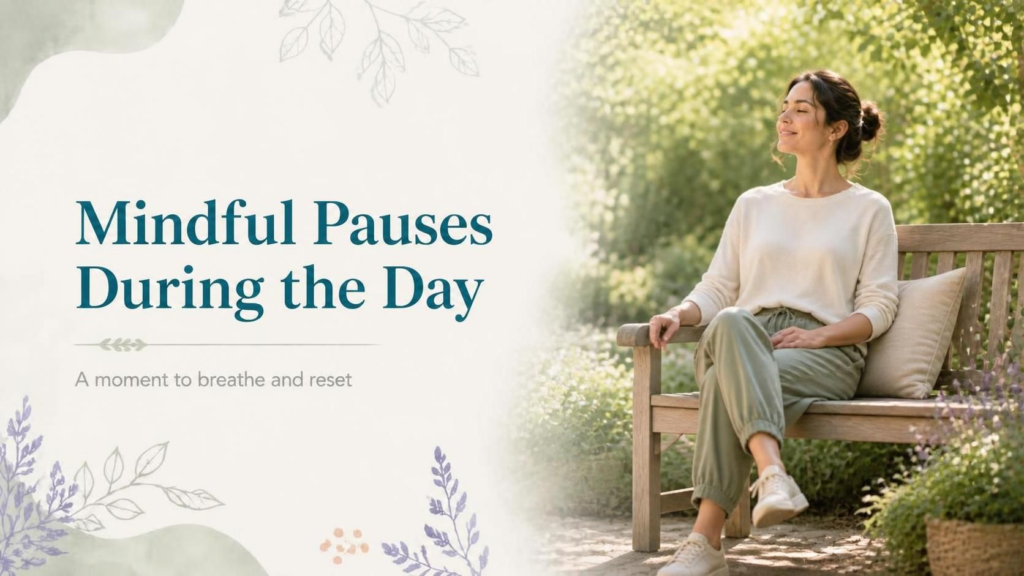
Welcome to Day 5 of the 7-Day Wellness Reset! You have already explored your wellness habits, sleep routine, everyday nutrition, and physical activity. Today, you will learn how to create mindful pauses in your day—small moments when you step back from your activities and pay attention to the present moment.
Your day may be filled with work, family responsibilities, messages, and tasks that compete for your attention. You do not need to change your entire schedule to make room for a pause. Even a brief moment of awareness can help you notice how you feel, what you are doing, and what you need next.
Mindfulness is not about emptying your mind or forcing yourself to feel calm. It is about noticing the present moment with curiosity, without immediately judging or trying to change everything you experience.
Table of Contents
Why Mindful Pauses Matter
When you move from one task to another without stopping, you may have little time to notice your thoughts, feelings, or physical needs. A mindful pause gives you an opportunity to check in with yourself before continuing your day.
For example, you might notice that you are tired after a long work session, distracted by several unfinished tasks, or simply ready to stretch and change position. Recognizing what is happening can help you make a more deliberate choice about your next step.
Mindfulness practices are not a replacement for professional mental health care, and their effects vary from person to person. For a general introduction, explore the National Center for Complementary and Integrative Health’s information on meditation and mindfulness.
Step 1: Notice When You Need a Pause
You do not have to wait until you feel overwhelmed to take a mindful pause. You can use everyday moments as reminders to stop briefly and notice what is happening around you and within you.
Consider these opportunities:
- Before starting work: Take a moment to identify the task you want to focus on first.
- After finishing a task: Pause before immediately opening another email or starting another activity.
- During a busy afternoon: Notice whether you need a drink of water, a change of position, or a short break.
- Before a meal: Take a moment to notice the food in front of you and prepare to eat without rushing.
- At the end of the day: Reflect briefly on what went well and what you would like to approach differently tomorrow.
Choose one moment that already exists in your routine. Connecting your pause to an established activity can make it easier to remember.
Step 2: Try a Simple Three-Minute Mindful Pause
This short exercise offers a practical way to begin. You can try it while sitting comfortably at home, taking a break at work, or enjoying a quiet moment in another suitable place.
Minute 1: Notice the Present Moment
Stop what you are doing, if it is safe and practical to do so. Notice your surroundings, the sounds you can hear, and the way your body feels in its current position.
You do not need to label everything or make any changes. Simply observe what is happening right now.
Minute 2: Check In With Yourself
Ask yourself a few gentle questions:
- What am I noticing in my body?
- What thoughts are occupying my attention?
- What emotion, if any, am I aware of right now?
- What might help me approach the next part of my day?
There is no need to find a perfect answer. If your mind feels busy, simply acknowledge that you have many things on your mind.
Minute 3: Choose Your Next Step
Decide what would be useful to do next. You might return to your task, stretch gently, get a drink of water, write down something you need to remember, or take another short break if your circumstances allow.
The purpose of this exercise is not to force a particular feeling. It is to create a little space between one activity and the next so you can respond more deliberately.
Step 3: Use Your Senses to Ground Your Attention
If your thoughts are moving quickly, focusing on your surroundings may offer a simple way to reconnect with the present moment. This is often called a grounding exercise.
Try the following gentle practice:
- Look: Notice three objects around you and observe their colors, shapes, or textures.
- Listen: Identify two sounds you can hear without needing to judge them.
- Feel: Notice one physical sensation, such as your feet touching the floor or your hands resting on a surface.
Take your time with each step. You can adapt the exercise to suit your environment and abilities. There is no need to complete it perfectly or identify a specific number of sensations if that feels uncomfortable.
If focusing on your body or breathing makes you feel uneasy, skip that part and direct your attention toward a neutral object in your surroundings. You can also stop the exercise at any time and choose another activity that feels more comfortable.
Step 4: Bring More Awareness to Everyday Activities
Mindful pauses do not always require you to sit quietly with your eyes closed. You can practice paying attention while doing ordinary activities.
- While drinking water: Notice the glass in your hand and take a moment before returning to your tasks.
- While eating: Pay attention to the taste, texture, and smell of your food when practical.
- While walking: Notice your surroundings and the rhythm of your steps, while remaining aware of your safety.
- While getting ready: Focus on one part of the task rather than mentally rushing through everything that comes next.
- While listening to someone: Give the conversation your attention instead of preparing your response before the other person has finished speaking.
You may find that some activities are easier to approach mindfully than others. Choose one that feels natural and practice it without expecting every moment to feel peaceful.
Step 5: Make Mindful Pauses Part of Your Routine
A useful habit needs a practical reminder. Instead of relying on memory alone, connect your mindful pauses to activities that already happen every day.
Here are a few ways to do that:
- Take three slow, comfortable breaths before beginning a routine task, if focusing on breathing feels comfortable.
- Pause briefly after completing your morning routine.
- Use a regular break as a reminder to notice your surroundings.
- Place a small written reminder near your workspace.
- Take a moment to reflect before switching from work to personal time.
Start with one pause per day. If that becomes easy to remember, you can add another when it suits your schedule. You do not need to set reminders for every hour or turn mindfulness into another demanding responsibility.
Step 6: Let the Practice Be Flexible
Some days, you may find it easy to pause and pay attention. On other days, your schedule may be full or your thoughts may feel difficult to settle. Both experiences are normal.
If a quiet exercise does not suit you, try a brief sensory activity or focus on a familiar task. If you do not have three minutes, take thirty seconds to notice your surroundings. If you forget your pause entirely, simply try again when you remember.
Mindfulness is a practice, not a performance. You are not trying to achieve a perfect state of calm. You are learning to notice the present moment and choose your next action with a little more awareness.
Your Day 5 Mindful Pause Check-In
Use these prompts to decide how you will practice today. Write your answers in your wellness notes or personal planner.
- One moment when I could use a pause: ____________________
- A reminder I can connect to that moment: ____________________
- A grounding activity I would like to try: ____________________
- One activity I can do with more awareness: ____________________
- My mindful pause for today: ____________________
Today’s Small Action
Today, take one mindful pause at a time that suits your schedule. Spend a minute noticing your surroundings, checking in with yourself, or paying attention to an everyday activity.
Make your action specific. Instead of saying, “I will be more mindful,” try, “After I finish lunch, I will take one minute to notice my surroundings before returning to work.”
Afterward, ask yourself whether the pause was practical and whether you would like to repeat it. You do not need to feel completely relaxed for the exercise to count. Simply making time to notice the present moment is enough to practice the habit.
What Comes Next?
Continue with Day 6: Make Healthy Habits Easier to Repeat. You will learn how to connect small actions to existing routines, prepare for common obstacles, and make your wellness habits more practical to maintain.
Keep your notes for Day 7, when you will create your personal 30-day wellness plan. You can also explore the free wellness guides for additional educational resources.
A Friendly Reminder
Mindful pauses are an opportunity to slow down briefly and notice your experience, not a demand to feel calm or positive all the time. Choose practices that feel comfortable, adapt them to your circumstances, and allow yourself to stop if an exercise feels unpleasant.
This lesson provides general educational information and is not a substitute for personalized mental health care. If you are experiencing persistent distress or need support with your mental health, consider speaking with a qualified healthcare professional.