What is Mindful Movement? 7 Incredible Benefits for Beginners
“Discover how mindful movement can transform your physical and mental well-being. Learn 7 science-backed benefits of connecting your breath with motion, and start your journey with this simple beginner’s guide at Wellness Advice Hub.
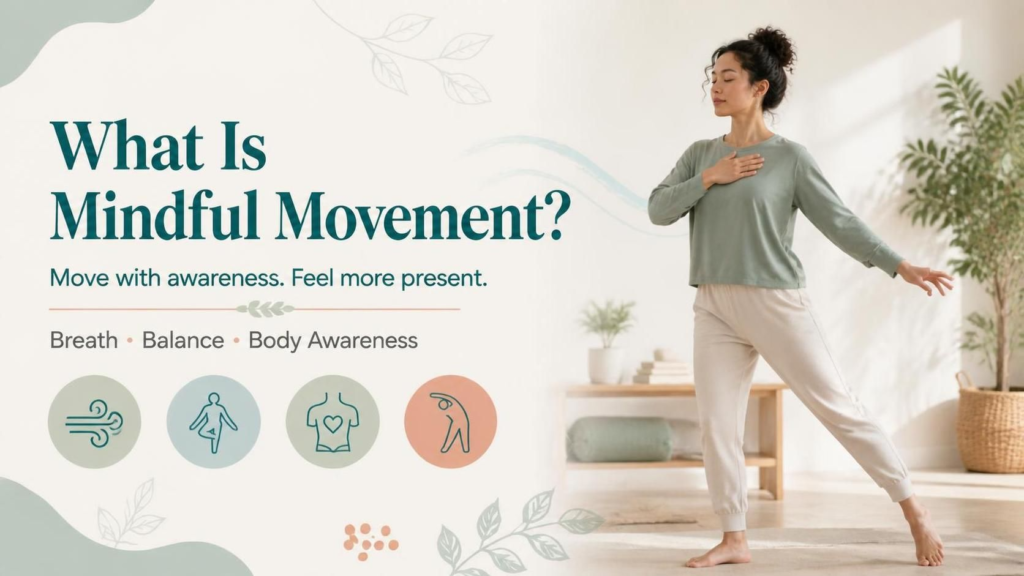
Introduction: What Is Mindful Movement?
Have you ever finished a workout feeling physically tired but mentally disconnected from your body? Exercise can certainly improve fitness, strength, mobility, and overall health, but movement does not always have to be about calories, repetitions, speed, or performance.
Mindful movement offers a different approach. Instead of moving automatically while thinking about everything else, you intentionally bring your attention to your body, breathing, movement, and physical sensations as they happen. A simple stretch, walk, yoga sequence, mobility exercise, or gentle bodyweight movement can become more mindful when you pay attention to the experience rather than simply trying to finish it.
In this guide, we will explain what mindful movement is, explore seven potential benefits, and show you several simple ways to practice it at home or during an ordinary day.
What Is Mindful Movement?
Mindful movement is movement performed with deliberate, present-moment awareness. Rather than allowing your body to move entirely on autopilot, you pay attention to sensations such as muscle tension, balance, breathing, posture, joint position, and the way your body responds to each movement.
Researchers use the term in somewhat different ways, but a common theme is the combination of physical movement and conscious attention to the present experience. In this sense, mindful movement is less about performing a movement perfectly and more about noticing what is happening while you move. :contentReference[oaicite:2]{index=2}
This means that mindful movement does not have to be a complicated workout. You could practice it while stretching in the morning, walking through your neighborhood, performing a mobility routine, or doing a familiar exercise more slowly and attentively.
Table of Contents
7 Benefits of Mindful Movement for Beginners
The potential benefits of mindful movement are not about one magical exercise or a guaranteed physical transformation. Instead, the practice may help you develop greater awareness of your body and create a more intentional relationship with everyday movement.
1. Improves Body Awareness
One of the clearest features of mindful movement is increased attention to physical sensations. You may begin noticing where you hold tension, how your posture changes, whether one side of your body feels different from the other, or when a particular movement feels uncomfortable.
This awareness can make exercise more intentional. Instead of automatically pushing through every movement, you become better at noticing your body’s signals and adjusting your technique or intensity when appropriate. Research on mindfulness-based interventions has also examined body awareness as one possible pathway through which mindfulness practices may influence well-being. :contentReference[oaicite:3]{index=3}
2. May Help Reduce Stress
When you deliberately focus on your breathing, body sensations, and the movement itself, you give your attention a specific task in the present moment. For some people, this can make movement feel calmer and less mentally demanding.
Recent research on combined mindfulness and physical activity suggests that these approaches may help reduce stress-related outcomes compared with some control conditions. However, results vary between studies, so mindful movement should be viewed as one possible stress-management practice rather than a guaranteed treatment. :contentReference[oaicite:4]{index=4}
3. Supports Mental Clarity and Present-Moment Attention
It is easy to walk, stretch, or exercise while mentally replaying yesterday’s problems or planning tomorrow’s tasks. Mindful movement gives you an opportunity to return your attention to something concrete: the rhythm of your steps, the position of your hands, the movement of your shoulders, or the sensation of your feet touching the ground.
You will still notice distracting thoughts. The goal is not to empty your mind. Instead, you notice when your attention has wandered and gently return it to the movement or sensation you are experiencing.
4. May Support Emotional Regulation
Mindfulness involves noticing thoughts, emotions, and physical sensations without immediately reacting to them. When this approach is combined with movement, your body can become a practical anchor for returning attention to the present moment.
Research on mindfulness and movement-based interventions has reported potential benefits for emotional well-being, although the evidence differs according to the type of intervention, population, and study design. :contentReference[oaicite:5]{index=5}
5. Encourages a Gentler Approach to Flexibility
Flexibility work does not have to become a competition. When you practice mindful movement, you can pay attention to the sensation of a stretch instead of forcing yourself toward a particular range of motion.
A useful principle is simple: a stretch may feel challenging, but it should not require you to ignore sharp pain or other warning signals. Moving within a comfortable range and gradually developing mobility can make your practice more sustainable.
6. May Help You Respond More Carefully to Pain and Tension
Mindful movement is not a cure for chronic pain, and it should not replace appropriate medical care. However, mindfulness-based approaches have been studied in relation to pain perception, coping, and quality of life.
Recent reviews suggest that mindfulness-based interventions can have useful effects for some people with chronic pain, but the results are mixed and vary according to the condition and intervention. :contentReference[oaicite:6]{index=6}
For everyday movement, the practical lesson is to become more attentive to your body’s signals rather than automatically pushing through discomfort.
7. Makes Everyday Movement More Intentional
You do not need a separate hour in your schedule to practice mindful movement. Walking to another room, standing up from your desk, climbing stairs, stretching before bed, or taking a short walk can all become opportunities to pay attention to your body.
This makes mindful movement particularly accessible for beginners. Instead of thinking that mindfulness requires a special setting, you can gradually incorporate short moments of awareness into activities you already perform.
Pro Tip: You do not need to move slowly all the time to practice mindful movement. The key is paying deliberate attention to what you are doing and how your body responds.

Simple Tools for Your Mindful Movement Practice
You do not need expensive equipment to begin practicing mindful movement. The most important tool is your attention. Still, a few simple items can make movement at home more comfortable and stable.
- Exercise mat: A stable, non-slip surface can make stretching, mobility exercises, and floor-based movement more comfortable.
- Comfortable clothing: Choose clothing that allows you to move without restricting your range of motion.
- A quiet space: You do not need complete silence, but reducing unnecessary distractions can make it easier to keep your attention on the practice.
- A few uninterrupted minutes: Even a short practice can give you an opportunity to focus on your breathing and physical sensations.
If you want to practice at home, a good-quality exercise mat is one of the simplest pieces of equipment to consider.
Editor’s Choice: A high-density non-slip exercise mat can provide a more stable surface for stretching, mobility work, and gentle home workouts.
How to Practice Mindful Movement at Home
You can begin mindful movement without a gym membership or complicated routine. Start with a few minutes and focus on the quality of your attention rather than the length of the session.
1. Try a Mindful Morning Stretch
Before beginning your day, spend three to five minutes moving gently. Roll your shoulders, stretch your arms, move your neck comfortably, and notice how each movement feels.
Rather than trying to stretch as far as possible, pay attention to your breathing and the sensations in the muscles you are moving.
2. Practice Conscious Walking
Walking is one of the easiest ways to introduce mindful movement into an ordinary day. Notice the contact between your feet and the ground, the movement of your legs, the rhythm of your breathing, and the position of your posture.
If your attention wanders, simply notice it and return your attention to walking. You do not need to make the walk longer or faster for it to become a mindfulness practice.
3. Combine Gentle Movement With a Body Scan
Stand or sit comfortably and begin with a few natural breaths. Slowly bring your attention from one area of your body to another. Notice your shoulders, arms, chest, abdomen, hips, legs, and feet.
You can add gentle movements while doing this. For example, relax your shoulders as you breathe out or slowly move your arms while paying attention to the sensations that arise.
How to Add Mindful Movement to a Home Workout
Mindful movement does not mean that every workout must become slow or meditative. You can apply the same principle to strength training, mobility work, or a full-body home workout.
- During squats: Notice your foot position, balance, knee movement, and breathing.
- During push-ups: Pay attention to your hand position, body alignment, and controlled movement.
- During stretching: Notice the sensation of the stretch without forcing your range of motion.
- Between exercises: Take a moment to notice your breathing and how your body feels before beginning the next movement.
If you are looking for a structured beginner-friendly routine, you can also explore our guide to 10 Best Home Workout Plans for Beginners.
Overcoming Common Challenges
Starting a mindful movement practice can sound simple, but maintaining attention is not always easy. Your mind may wander, your schedule may become busy, or you may expect yourself to perform the movements perfectly.
- Your mind keeps wandering: This is normal. Notice the distraction and gently return your attention to your breathing or movement.
- You feel impatient: Start with only two or three minutes. There is no requirement to begin with a long session.
- You compare yourself with others: Mindful movement is not a competition. Pay attention to your own sensations and abilities.
- You push too hard: Awareness should include noticing discomfort. Sharp or unusual pain is a reason to stop rather than push through it.
Consistency matters more than perfection. A few attentive minutes that you can repeat regularly may be more realistic than designing an elaborate routine that you rarely follow.
Frequently Asked Questions About Mindful Movement
Do I need to be flexible to start mindful movement?
No. Flexibility is not a requirement. You can begin with comfortable, simple movements and gradually improve your mobility as your body adapts. The focus is on awareness and controlled movement rather than performing advanced stretches.
How is mindful movement different from regular stretching?
Regular stretching can be performed mainly to improve flexibility or mobility. Mindful movement adds deliberate attention to the sensations, breathing, posture, and quality of the movement while you perform it.
Can I practice mindful movement at work?
Yes. You can practice short moments of mindful movement at your desk or during a break. For example, you can stand, move your shoulders gently, take a few comfortable breaths, and pay attention to your posture and physical sensations.
Is mindful movement the same as yoga?
Not necessarily. Yoga can include mindful movement, but mindful movement is a broader concept. Walking, stretching, mobility exercises, tai chi, and ordinary exercises can all be practiced mindfully when they are performed with deliberate present-moment awareness.
How long should I practice mindful movement?
There is no single required duration. Beginners can start with a few minutes and gradually build a routine that fits their schedule. The goal is to develop consistent awareness rather than reach a specific number of minutes.
The Science Behind Mindful Movement
The scientific literature does not treat mindful movement as one single standardized exercise. Different studies use different combinations of mindfulness training, physical activity, yoga, tai chi, dance, mobility work, or other movement practices. This makes it important to avoid treating every study as evidence for exactly the same practice.
A useful way to understand the concept is to focus on attention. During ordinary movement, many actions become automatic. Mindful movement deliberately brings some of your attention back to the physical experience: how you are moving, what you are sensing, and how your body responds.
Research also suggests that body awareness is an important component studied within mindfulness-based interventions. However, the mechanisms behind the effects of mindfulness are complex, and researchers continue to investigate how attention, emotion, body awareness, and other factors interact. :contentReference[oaicite:7]{index=7}
Recent meta-analytic research has also examined interventions combining mindfulness with physical activity. Some findings suggest benefits for stress, anxiety, or depression-related outcomes, but differences between programs and participants mean that results should not be interpreted as a guarantee for everyone. :contentReference[oaicite:8]{index=8}
For Wellness Advice Hub readers, the practical takeaway is simple: use mindful movement as a way to become more attentive to your body and present experience, while keeping realistic expectations about what the practice can and cannot do.
Common Mistakes to Avoid
As you begin practicing mindful movement, avoid turning the practice into another source of pressure.
- Trying to perform perfectly: Mindfulness is about awareness, not perfection.
- Forcing stretches: A deeper stretch is not automatically a better stretch.
- Holding your breath: If you notice yourself holding your breath during a movement, pause and return to comfortable breathing.
- Expecting instant results: Mindful movement is a practice. Give yourself time to become familiar with it.
- Ignoring pain: Mindfulness includes noticing warning signals. Stop an exercise if you experience sharp, severe, or unusual pain.
Creating a Comfortable Space for Mindful Movement
You do not need a special studio to practice mindful movement. A small area where you can move safely and without unnecessary distractions is enough.
- Choose a stable surface where you can move comfortably.
- Keep your exercise mat available if you use one.
- Reduce unnecessary distractions for a few minutes.
- Use comfortable lighting and clothing.
- Keep the space practical rather than worrying about creating a perfect “Zen” environment.
The purpose of the space is simply to make it easier for you to begin and maintain your practice.
Making Mindful Movement Part of Your Wellness Routine
The easiest way to make mindful movement sustainable is to connect it with something you already do.
- Stretch for a few minutes after waking up.
- Take a short mindful walk during a break.
- Pay attention to your breathing during strength exercises.
- Perform a few gentle mobility movements after sitting for a long period.
- End an evening workout with a few quiet minutes of body awareness.
If you want to build a broader home fitness routine, you can also read our guide to full-body workouts at home and combine structured exercise with greater awareness of how your body moves.
Conclusion: Start With One Mindful Movement Today
Mindful movement is not about turning every workout into a meditation session or moving perfectly. It is a simple way to bring more attention to your body and the experience of moving.
You can begin with a few minutes of stretching, a short walk, or a familiar exercise performed with more attention to your breathing, posture, balance, and physical sensations.
Over time, this approach may help you develop a more attentive and sustainable relationship with movement. The goal is not to conquer your body. It is to understand it better, respect its signals, and make movement a more intentional part of everyday life.
For more practical wellness and movement guidance, explore the Wellness Advice Hub and discover more ways to support your energy, movement, and everyday well-being.
Selected Scientific References
- Dance as mindful movement: a perspective from motor learning and predictive coding
- Integrating mindfulness and physical activity: a meta-analysis of mindful movement interventions
- The Combined Effect of Mindfulness and Physical Activity on Stress
- Mindfulness-Based Interventions and Body Awareness
- A synthesis of meta-analyses of mindfulness-based interventions in pain
Disclaimer: This article is for general educational and wellness information only. Mindful movement is not a substitute for medical diagnosis or treatment. If you have an injury, persistent pain, a medical condition, or concerns about starting exercise, consult an appropriately qualified healthcare professional.
About The Author

