Top 10 Full Body Workout at Home: For Men, Women & Beginners
Discover a practical Full Body Workout at Home with 10 effective exercises, a 20-minute routine, beginner-friendly modifications, and a simple weekly workout plan you can follow with little or no equipment.
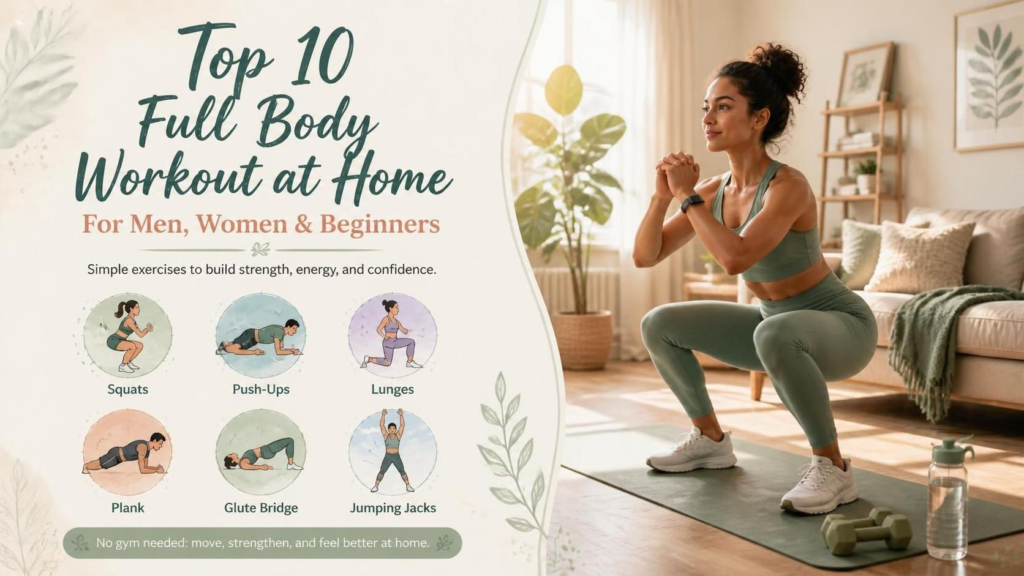
Looking for an effective Full Body Workout at Home without a gym or expensive equipment? This guide gives you a practical way to train your major muscle groups using bodyweight exercises, with options for beginners and more experienced exercisers.
You’ll find a 20-minute full body workout at home you can follow, 10 essential exercises, beginner modifications, a simple weekly training plan, and tips for progressing over time. Most of the exercises require no equipment, so you can adapt the routine to your space, fitness level, and available time.
Quick Overview
Level: Beginner to intermediate
Equipment: None required
Workout focus: Full-body strength, muscular endurance, and conditioning
Workout format: 20-minute routine + individual exercise guide
Best for: Home workouts, beginners, and anyone looking for a simple bodyweight routine
Table of Contents
20-Minute Full Body Workout at Home
If you want a simple full body workout at home you can do right away, start with this bodyweight routine.
Level: Beginner to intermediate
Equipment: None
Duration: About 20 minutes
Warm-Up — 3 Minutes
Spend about 30 seconds on each movement:
- March in place
- Arm circles
- Hip hinges
- Bodyweight squats
- Alternating reverse lunges
- Easy step jacks or gentle jumping jacks
Keep the pace comfortable and use the warm-up to prepare your body for the movements that follow.
Main Workout — 15 Minutes
Complete 2–3 rounds. Rest for about 30–60 seconds between exercises as needed, and take a longer break between rounds if necessary.
| Exercise | Reps / Time | Beginner Option |
|---|---|---|
| Bodyweight Squats | 10–15 reps | Use a chair for support |
| Incline Push-Ups | 8–12 reps | Use a higher, stable surface |
| Reverse Lunges | 6–10 reps per leg | Hold a wall or reduce the range of motion |
| Glute Bridges | 10–15 reps | Use a smaller range of motion |
| Bird Dogs | 6–10 reps per side | Move slowly and pause between repetitions |
| Marching in Place | 30–45 sec | Keep the pace easy |
Focus on controlled movements rather than trying to complete the workout as quickly as possible. Stop or modify an exercise if you experience pain.
Cool-Down — 2 Minutes
Finish with easy walking or marching in place, followed by gentle stretches for the muscles you worked.
How to Progress Your Full Body Workout at Home
When this routine becomes easier, progress gradually rather than simply adding more and more repetitions. You can increase the number of rounds, use a slightly harder exercise variation, add controlled resistance, or gradually increase the work time.
If you are new to exercise, start with fewer repetitions, longer rest periods, or just 1–2 rounds and build up gradually.
Guided Full Body Workout at Home Video
Prefer following along with a video for your full body workout at home rather than reading through a workout plan? This 20-minute full-body workout from FitnessBlender provides a guided option you can follow at home without equipment.
The workout combines a variety of strength and conditioning movements. Adjust the pace, range of motion, or exercise as needed for your fitness level, and take additional rest when necessary.
Watch the workout here:
Why Full Body Workout at Home Works Well
A full-body workout combines exercises that train several major muscle groups in the same session. This makes it a practical option if you prefer exercising at home or have limited time for training.
Bodyweight movements such as squats, push-ups, lunges, glute bridges, and core exercises can help develop strength and muscular endurance without requiring gym machines. You can also modify many exercises to match your current fitness level and gradually make them more challenging as you progress.
For beginners, the most important goal is to learn the movements, use a manageable level of effort, and build a routine you can maintain consistently.
👉 According to Harvard Health, a regular full body workout at home using bodyweight training can help improve strength and support overall physical fitness, even without gym machines.
10 Best Full-Body Exercises to Do at Home
These bodyweight exercises can be adapted to different fitness levels and used individually or as part of a Full Body Workout at Home. Focus on controlled movement and choose a variation that you can perform with good form.
1. Bodyweight Squats
Targets: Quads, glutes, hamstrings
Stand with your feet about shoulder-width apart. Bend your knees and hips to lower your body comfortably, keeping your chest lifted and your feet stable. Press through your feet to return to the starting position.
Beginner option: Squat to a chair or reduce the depth.
Try: 8–15 repetitions.
2. Push-Ups
Targets: Chest, shoulders, triceps, core
Start in a high-plank position with your hands slightly wider than your shoulders. Lower your body with control while keeping your body aligned, then press back up.
Beginner option: Perform push-ups against a wall or a stable elevated surface.
Try: 6–12 repetitions.
3. Reverse Lunges
Targets: Quads, glutes, hamstrings
From a standing position, step one foot backward and lower your body under control. Push through the front foot to return to standing, then switch sides.
Beginner option: Hold onto a wall or sturdy support for balance.
Try: 6–10 repetitions per leg.
4. Glute Bridges
Targets: Glutes, hamstrings, hips
Lie on your back with your knees bent and your feet planted on the floor. Lift your hips until your body forms a comfortable line from your shoulders toward your knees, then lower with control.
Beginner option: Use a smaller range of motion.
Try: 10–15 repetitions.
5. Bird Dogs
Targets: Core, back, hips, shoulders
Start on your hands and knees. Slowly extend one arm and the opposite leg while keeping your torso as stable as possible. Return to the starting position and switch sides.
Beginner option: Start by moving only one arm or one leg at a time.
Try: 6–10 repetitions per side.
6. Plank
Targets: Core, shoulders
Support yourself on your forearms or hands and keep your body in a comfortable, controlled position. Brace your core without holding your breath or allowing your lower back to sag.
Beginner option: Use a higher surface such as a sturdy bench or table, or shorten the hold.
Try: 15–30 seconds.
7. Superman
Targets: Back, glutes, shoulders
Lie face down with your arms extended comfortably. Lift your arms and legs slightly from the floor while keeping the movement controlled, then lower them back down.
Beginner option: Lift only your arms or only your legs at first.
Try: 8–12 repetitions.
8. Mountain Climbers
Targets: Core, shoulders, legs
Start in a high-plank position. Bring one knee toward your chest, return it, and alternate sides. Begin slowly and increase the pace only if you can maintain control.
Beginner option: Perform the movement slowly or use an elevated surface.
Try: 20–30 seconds.
9. Step Jacks
Targets: Legs, shoulders, cardiovascular fitness
Step one foot out to the side while raising your arms, then return to the starting position and switch sides. Continue at a comfortable pace.
Beginner option: Keep the movement low impact by stepping instead of jumping.
Try: 30–45 seconds.
10. Triceps Dips
Targets: Triceps and shoulders
If you choose to use a chair or other stable surface, keep it firmly positioned and perform the movement through a comfortable range of motion. Keep your shoulders controlled and avoid lowering farther than feels comfortable.
Beginner option: Skip dips and use incline push-ups or another upper-body exercise if the movement causes shoulder discomfort.
Try: 6–10 repetitions.
3 Bonus Exercises for Your Full Body Workout at Home
Once you are comfortable with the basic exercises above, you can add these movements for variety or additional conditioning.
11. High Knees
High knees are a simple way to add a faster-paced conditioning movement to a home workout.
Beginner option: March in place and gradually increase your pace.
Try: 20–30 seconds.
12. Bear Crawl
Bear crawls challenge the core, shoulders, arms, and legs while requiring coordination and control.
Beginner option: Practice the movement slowly over a short distance, or hold a bear position without moving.
Try: 15–30 seconds.
13. Side Plank with Leg Lift
This more advanced variation challenges the side of the core while also requiring hip stability.
Beginner option: Start with a regular side plank, using your lower knee for support if needed.
Try: 10–20 seconds per side.

Weekly Full-Body Workout Plan for Beginners
If you are new to home workouts, you do not need to train hard every day. A simple schedule with Full Body Workout at Home strength sessions, recovery days, and optional light activity can be easier to maintain.
| Day | Plan |
|---|---|
| Day 1 | Full-Body Workout — Complete the 20-minute workout above. |
| Day 2 | Recovery / Light Activity — Take a walk, do gentle mobility work, or rest. |
| Day 3 | Full-Body Workout — Repeat the workout, using easier or harder variations as appropriate. |
| Day 4 | Rest or Light Activity — Choose an easy walk or mobility session if you feel comfortable. |
| Day 5 | Optional Full-Body Workout — Train if you feel recovered; otherwise, take another recovery day. |
| Day 6 | Light Activity or Mobility — Walking, gentle stretching, or another comfortable activity. |
| Day 7 | Rest — Give your body time to recover. |
How to Progress
Start with the number of rounds and exercise variations you can complete with good control. As the routine becomes easier, gradually increase the challenge by adding repetitions, extending work time, adding a round, or moving to a more challenging variation.
You do not have to complete every optional workout. If you are new to exercise or need more recovery time, start with two full-body sessions per week and build up gradually.
Common Mistakes to Avoid in a Full Body Workout at Home
Even a well-designed home workout can be less effective when you rush through the movements or progress too quickly. Keep these common mistakes in mind:
- Skipping a gradual warm-up
Start with a few minutes of easy movement to prepare your body for the workout. A cool-down can then help you transition back to normal activity. - Sacrificing form for speed or repetitions
Use a range of motion and pace that you can control. If your technique starts to break down, reduce the repetitions or choose an easier variation. - Doing too much too soon
You do not need to start with the hardest variation or the highest number of repetitions. Increase the challenge gradually as your fitness improves. - Ignoring recovery
Training is only one part of a fitness routine. Give your body enough time to recover, especially after demanding workouts, and avoid repeatedly training through significant pain. - Not tracking your progress
You can use a notebook, phone, or app to record repetitions, sets, workout duration, or exercise variations. Tracking your workouts can make gradual progress easier to see.
Simple Alternatives for a Full Body Workout at Home
You do not need dumbbells, resistance bands, or a home gym to complete the workout in this guide. However, a few everyday items can provide optional support or light resistance.
- Stable chair: Can be useful for incline push-ups, supported exercises, or sit-to-stand squats. Make sure the chair is sturdy and placed on a non-slip surface.
- Water bottles or a backpack: These can provide light resistance for selected exercises. Start with a manageable load and make sure the items are secure.
- Towel: Can be useful for certain sliding exercises when the surface is suitable and safe for the movement.
- Wall: A wall can provide support for movements such as wall sits or balance-focused exercises.
Choose equipment only when it makes an exercise more comfortable or appropriately challenging. You should not need household items to complete the main bodyweight routine above.
Nutrition Tips for At-Home Workouts
Exercise is only one part of supporting your fitness goals. A balanced eating pattern can help provide the energy and nutrients your body needs for training and recovery.
Prioritize Protein
Include protein-rich foods such as eggs, Greek yogurt, lentils, beans, fish, poultry, or other protein sources that fit your diet. Protein supports muscle repair and adaptation, especially when combined with regular resistance training.
Include Carbohydrates for Training Energy
Carbohydrate-rich foods such as fruit, potatoes, whole grains, beans, and other minimally processed sources can provide energy for physical activity. Your needs may vary depending on your activity level and overall diet.
Don’t Skip Healthy Fats
Foods such as nuts, seeds, avocados, and olive oil can contribute healthy fats and other nutrients to a balanced diet. You don’t need to eliminate fats to support your fitness goals.
Stay Hydrated
Drink fluids regularly throughout the day and pay attention to your thirst, especially when exercising in hot conditions or sweating more than usual. Your fluid needs vary with factors such as activity, climate, body size, and diet.
What About Pre- and Post-Workout Meals?
You do not need a complicated meal-timing strategy to benefit from exercise. Depending on when you train, a simple meal or snack containing carbohydrates and/or protein can be a practical choice.
For more ideas about foods that can support energy and everyday nutrition, see our guide to foods that increase energy.
Frequently Asked Questions
1. Can I get fit with a full-body workout at home?
Yes. Regular home workouts can help improve strength, muscular endurance, and overall fitness. Your results depend on factors such as your training routine, progression, nutrition, recovery, and starting fitness level.
2. How long should a full-body workout at home last?
There is no single ideal workout length for everyone. A well-structured session can be relatively short, especially when you focus on a few effective movements. The 20-minute routine in this guide is one practical option.
3. Do I need equipment for a full-body workout at home?
No. The main workout in this guide uses bodyweight exercises and does not require equipment. Resistance bands, dumbbells, or other equipment can be added later if you want additional resistance or exercise variety.
4. Can beginners do these full-body exercises?
Yes, many of these exercises can be adapted for beginners. Start with easier variations, fewer repetitions, shorter work periods, and longer rest periods when needed. Focus on controlled movement before increasing the difficulty.
5. How often should I do a full-body workout?
For beginners, two full-body strength sessions per week can be a reasonable starting point. You can gradually increase your training frequency as your fitness and recovery improve. Your weekly schedule should include time for recovery rather than demanding hard training every day.
6. Can I lose weight with a no-equipment workout plan?
Home workouts can contribute to weight management by increasing physical activity and helping you maintain or build muscle. However, weight loss depends on overall energy balance and other factors, including food intake and daily activity. Exercise alone does not guarantee weight loss.
7. Can women do the same full-body exercises?
Yes. Most bodyweight exercises in this guide can be performed by both women and men. The appropriate exercise variation, resistance, repetitions, and training volume can be adjusted to the individual’s fitness level and goals.
8. Do I need to warm up before a home workout?
A short, gradual warm-up can prepare your body for the movements and intensity of the workout. It does not need to be complicated. The routine in this guide includes a brief warm-up before the main exercises.
9. Can I build muscle without weights?
Yes. Bodyweight training can provide resistance that challenges your muscles. As you become stronger, you can progress by using more challenging exercise variations, increasing repetitions or work time, adding sets, or eventually using external resistance.
10. Can I do full-body workouts every day?
You do not need to perform challenging full-body strength workouts every day. Allow adequate recovery between demanding sessions, especially when you are new to exercise. Light walking or mobility work can be used on recovery days.
11. What is the best time of day to work out at home?
The best time is generally the time that fits your schedule and allows you to exercise consistently. Morning and evening workouts can both work, so choose a time you can maintain comfortably.
12. Can I combine home workouts with running?
Yes. Combining strength training with cardiovascular activity such as running can be part of a balanced fitness routine. Adjust the frequency and intensity of each activity so you have enough time to recover.
13. Do I need supplements to support my workouts?
Not necessarily. A balanced diet, adequate hydration, regular exercise, and sufficient sleep provide the foundation of a fitness routine. Supplements may have specific uses, but they are not a requirement for basic home workouts.
14. What is a good beginner-friendly Full Body Workout at Home?
A simple beginner routine can include movements such as squats, an appropriate push-up variation, reverse lunges, glute bridges, and a core exercise. The 20-minute workout near the beginning of this guide provides a complete starting option.
Final Thoughts
You do not need a gym to build a consistent fitness routine. A Full Body Workout at Home can help you work on strength, muscular endurance, mobility, and overall fitness using simple exercises and little or no equipment.
Start with a manageable number of exercises, focus on controlled movement, and give yourself enough time to recover. As the routine becomes easier, gradually increase the repetitions, work time, rounds, or exercise difficulty.
The most useful workout is not necessarily the hardest one. It is a routine you can perform safely, progress gradually, and maintain over time.
📥 Free Resource
Want a simple step-by-step plan to get started?
Download your 7-Day Home Workout Routine (PDF)
and start training today with zero equipment!
About The Author


