I Tested 7 Scientific Workouts That Burn the Most Calories at Home – Here’s the Winner
I tested 7 scientific workouts that burn the most calories at home to find the ultimate calorie burner. Discover which exercises torch fat fastest (backed by research) and learn my 20-minute routine to boost metabolism for 24 hours. No equipment needed!
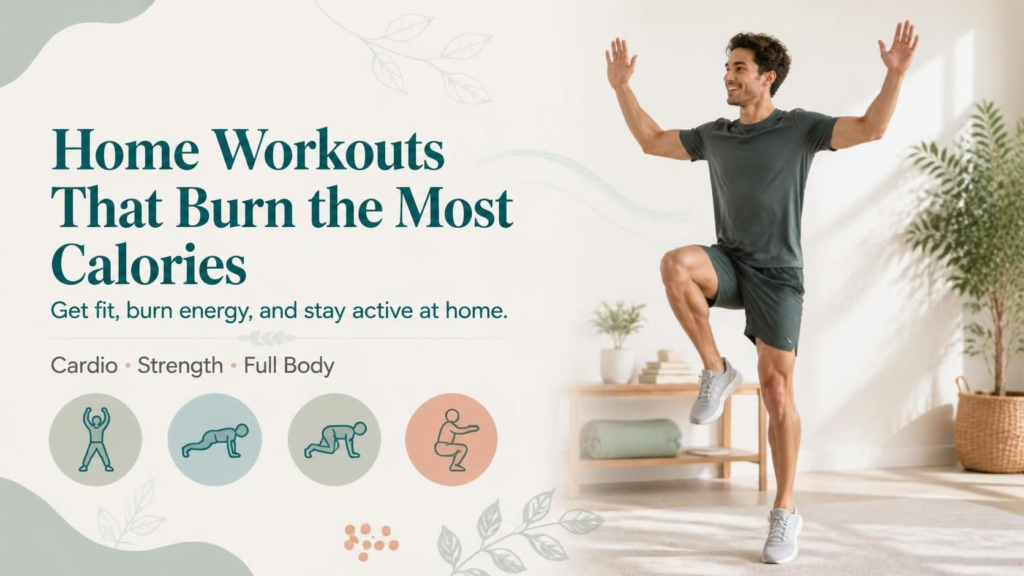
Calorie-Burning Workouts: What the Science Actually Tells Us
If you want to increase energy expenditure during exercise, some home workouts are more demanding than others. Exercises that involve several large muscle groups, continuous movement, and higher intensity can require substantially more energy than gentle or isolated movements.
However, there is no single workout that burns the same number of calories for everyone. Your body weight, exercise intensity, workout duration, fitness level, movement efficiency, and rest periods all affect energy expenditure.
That is why it is more useful to compare workouts that burn the most calories at home by their intensity and movement demands rather than promising an exact calorie number for every person.
Below, we look at seven equipment-free exercises that can be used to create demanding home workouts, along with what the science actually tells us about intensity, energy expenditure, and weight management.
These workouts that burn the most calories at home can be adjusted for different fitness levels by changing the pace, work interval, and recovery time.
Table of Contents
Comparison: 7 Workouts That Burn the Most Calories at Home
The following exercises can be performed at home with little or no equipment. They are listed as practical options for higher-intensity training rather than as a universal ranking of exact calorie expenditure.
| Workout | Typical Intensity | Why It Can Be Energy-Demanding | Equipment |
|---|---|---|---|
| HIIT Intervals | Vigorous | Alternates short periods of intense movement with recovery | None |
| Burpees | Vigorous | Combines upper-body, lower-body, and cardiovascular movement | None |
| Mountain Climbers | Moderate to vigorous | Continuous full-body movement performed at a controlled pace | None |
| Jump Squats | Vigorous | Combines a squat with explosive upward movement | None |
| Jumping Lunges | Vigorous | Uses large lower-body muscles with repeated explosive movement | None |
| Plank Jacks | Moderate to vigorous | Combines a plank position with repeated leg movement | None |
| Skater Jumps | Vigorous | Uses lateral movement, balance, and repeated lower-body effort | None |
When comparing workouts that burn the most calories at home, think about total workout time and intensity rather than relying on a single calorie number.
1. HIIT Intervals
High-intensity interval training, or HIIT, alternates relatively short periods of vigorous exercise with recovery periods. A home HIIT session can include movements such as jumping jacks, burpees, mountain climbers, squat jumps, or other bodyweight exercises.
Because HIIT can involve vigorous effort and relatively short recovery periods, it can produce a high exercise intensity without requiring gym equipment.
The 2024 Adult Compendium of Physical Activities lists vigorous interval-style calisthenic activity at a relatively high metabolic equivalent level. MET values are useful for standardized comparisons, but they should not be interpreted as a precise prediction of how many calories one particular person will burn.
HIIT can therefore be useful when building workouts that burn the most calories at home, especially when the intervals are appropriately challenging for your current fitness level.
For readers comparing workouts that burn the most calories at home, HIIT is one of the most flexible options because the intensity can be adjusted without adding equipment.
2. Burpees
Burpees combine several movements into one exercise: lowering toward the floor, moving the legs back, returning to a standing position, and often adding a jump.
For people who can perform them safely, burpees are a practical addition to workouts that burn the most calories at home because they combine upper-body, lower-body, and cardiovascular effort without requiring equipment.
The intensity can also be modified. Beginners can remove the jump or step the feet backward and forward instead of jumping. More experienced exercisers can increase the pace while maintaining good technique.
3. Mountain Climbers
Mountain climbers begin in a plank-like position and involve repeatedly driving one knee toward the chest and then switching sides. The movement requires the upper body to stabilize the position while the legs move continuously.
The intensity depends heavily on pace and technique. A controlled version may feel moderate, while a faster version can become considerably more demanding.
This makes mountain climbers another useful option when building workouts that burn the most calories at home, particularly when they are performed at a vigorous but controlled pace.
Keep your shoulders stable and avoid allowing your lower back to collapse as you increase speed.
4. Jump Squats
Jump squats combine a traditional squat pattern with an explosive jump. The exercise places substantial demand on the lower-body muscles and increases cardiovascular intensity through repeated jumping.
They can therefore be used as one component of workouts that burn the most calories at home, especially when combined with recovery periods and other full-body movements.
If jumping is uncomfortable or unsuitable for you, a regular bodyweight squat can provide a lower-impact alternative while still training the legs and hips.
5. Jumping Lunges
Jumping lunges add an explosive jump to the basic lunge movement. Because the exercise repeatedly loads the lower body while requiring balance and coordination, it can become highly demanding when performed continuously.
However, jumping lunges are not appropriate for everyone. People who are new to exercise, have joint concerns, or have difficulty maintaining stable landing mechanics may benefit from regular reverse or stationary lunges instead.
The goal should be to choose an intensity that you can perform with controlled technique rather than simply trying to move as quickly as possible.
6. Plank Jacks
Plank jacks combine a plank position with repeated outward and inward movement of the feet. The exercise challenges the core while also adding continuous lower-body movement.
Because the body has to maintain a stable position while the legs move repeatedly, plank jacks can become surprisingly demanding as the duration increases.
To reduce the intensity, step one foot outward at a time instead of jumping both feet. This allows you to practice the movement while reducing impact.
7. Skater Jumps
Skater jumps involve moving laterally from one side to the other while balancing on one leg during each landing. The exercise combines lower-body strength, coordination, balance, and cardiovascular effort.
Together, these exercises give you several ways to build workouts that burn the most calories at home without depending on gym machines or expensive equipment.
As with other jumping exercises, landing softly and maintaining control is more important than maximizing speed.
What About the Afterburn Effect?
One reason high-intensity exercise is sometimes promoted for calorie burning is excess post-exercise oxygen consumption, commonly called EPOC.
EPOC refers to the period after exercise when oxygen consumption remains elevated while the body returns toward its normal resting state. The effect is real, but it should not be treated as a magical metabolic boost that continues burning large amounts of calories for an entire day.
Research indicates that EPOC varies according to factors such as exercise intensity, duration, and the type of workout performed.
This is one reason HIIT is often included among workouts that burn the most calories at home, although the size of the post-exercise effect varies between people.
The practical lesson is simple: focus primarily on the energy you expend during a workout and on maintaining a sustainable exercise routine rather than choosing an exercise solely because of claims about a prolonged afterburn effect.
How to Maximize Calorie Burn During a Home Workout
If increasing energy expenditure is one of your goals, several factors can make a meaningful difference.
Increase Intensity Gradually
Moving faster is not automatically better. Increase intensity gradually while keeping your technique under control.
Use Full-Body Movements
Exercises involving several large muscle groups can require more overall effort than isolated movements.
Reduce Unnecessary Rest
Appropriate recovery is important, especially during vigorous training. However, excessively long breaks can reduce the overall intensity of a workout.
Increase Workout Duration When Appropriate
A demanding five-minute session and a demanding twenty-minute session do not create the same total energy expenditure. Duration matters alongside intensity.
Choose Movements You Can Repeat Consistently
The most useful workout is one you can perform regularly and recover from. An extremely difficult routine that you abandon after one week is unlikely to provide a long-term advantage.
When building workouts that burn the most calories at home, the goal should be to create enough intensity to challenge your body without sacrificing proper form or recovery.
Different workouts that burn the most calories at home can place different demands on your body, so alternating movements can help you build a more balanced routine.
Can These Workouts Help With Weight Loss?
Higher-intensity home workouts can contribute to weight management because physical activity increases energy expenditure. However, exercise is only one part of the overall picture.
Body weight is influenced by energy intake, physical activity, sleep, genetics, medications, health conditions, and other factors. A workout should therefore not be presented as a guaranteed method for losing a specific amount of fat.
Importantly, you cannot choose where your body loses fat first. Performing abdominal exercises, for example, does not guarantee that fat will be removed specifically from the abdomen.
A sustainable combination of regular physical activity, appropriate nutrition, adequate recovery, and realistic long-term habits is more useful than relying on one supposedly superior exercise.
A Simple 20-Minute Home Calorie-Burning Circuit
You can combine several of the exercises above into a short home workout. Adjust the duration and intensity according to your current fitness level.
Beginner-Friendly Structure
- 30 seconds of movement
- 30–60 seconds of recovery
- Repeat for 4–5 exercises
- Rest for 1–2 minutes between rounds
- Complete 2–3 rounds depending on your fitness level
Example Circuit
- Marching or low-impact jumping jacks
- Bodyweight squats
- Modified mountain climbers
- Step-back lunges
- Modified plank jacks
More experienced exercisers can use vigorous versions of these movements and shorter recovery periods when appropriate.
If you are new to exercise, there is no need to begin with the most difficult version of every movement. Progressively increasing your workload can be more sustainable.
How to Choose the Right Workout for You
The best exercise choice depends on your current fitness level, available space, physical limitations, preferences, and ability to recover.
The best choice depends on what your body can currently handle and what you enjoy enough to repeat. Even when your goal is to find workouts that burn the most calories at home, safety, consistency, and recovery should remain part of the decision.
If high-impact jumping is uncomfortable, choose lower-impact alternatives such as squats, step-back lunges, marching intervals, or controlled bodyweight circuits.
If you already exercise regularly and tolerate vigorous training well, you may gradually introduce more challenging intervals or jumping movements.
For additional ideas, see our guide to 10 Best Home Workout Plans for Beginners.
Safety Tips for High-Intensity Home Workouts
Higher-intensity exercise is not appropriate for everyone, and the most demanding option is not automatically the most useful option.
- Warm up before vigorous exercise.
- Start with lower-impact versions if you are new to training.
- Use controlled landing mechanics during jumping exercises.
- Stop if you experience unusual chest pain, severe dizziness, or significant shortness of breath.
- Allow adequate recovery between demanding sessions.
- Increase training volume gradually rather than making large jumps in intensity.
If you have a medical condition, significant joint problems, or have been inactive for a long period, consider speaking with a qualified healthcare professional before beginning vigorous exercise.
How Often Should You Do These Workouts?
There is no requirement to perform high-intensity workouts every day.
For general health, the CDC recommends that adults get at least 150 minutes of moderate-intensity aerobic activity per week or 75 minutes of vigorous-intensity activity, together with muscle-strengthening activities on at least two days per week.
Your weekly routine can include a mixture of moderate activity, strength training, walking, mobility work, and occasional vigorous sessions.
For many people, this balanced approach is more realistic than trying to perform the most intense workouts that burn the most calories at home every day.
Rather than repeating the same workouts that burn the most calories at home every day, combine challenging sessions with easier activities and adequate recovery.
Frequently Asked Questions
What workout burns the most calories at home?
There is no single workout that burns the most calories for every person. Vigorous activities such as HIIT, burpees, jumping exercises, and other full-body movements can create high energy demands, but actual calorie expenditure varies according to body size, intensity, duration, fitness level, and other factors.
Can I burn a lot of calories without equipment?
Yes. Bodyweight exercises such as burpees, mountain climbers, jumping squats, and HIIT intervals can be performed without gym equipment and can reach vigorous intensity.
Is HIIT better than walking for weight loss?
HIIT can produce greater exercise intensity in a shorter period, while walking is generally easier to perform frequently and recover from. The more appropriate choice depends on your fitness level, goals, preferences, and ability to maintain the activity consistently.
Do these workouts burn belly fat?
Exercise can contribute to overall fat loss when combined with an appropriate overall energy balance, but you cannot reliably direct your body to burn fat from one specific area by choosing particular exercises.
How long should a calorie-burning workout last?
There is no universal ideal duration. A short vigorous workout can be useful, while longer moderate sessions can also contribute meaningfully to total physical activity. Your fitness level, goals, schedule, and recovery capacity should guide the duration.
Scientific References
2024 Adult Compendium of Physical Activities – Conditioning Exercise
2024 Adult Compendium of Physical Activities – Corrected MET Values
High-Intensity Interval Training and Energy Expenditure
Exercise, EPOC, and Energy Expenditure
CDC – Health Benefits of Physical Activity for Adults
CDC – Losing Weight
Related Articles
10 Best Pre-Workout Snacks for Energy & Endurance
7 Best Leg Exercises at Home for Beginners
10 Best Home Workout Plans for Beginners
Final Thoughts
High-intensity bodyweight exercises can make home workouts challenging without requiring expensive equipment. HIIT intervals, burpees, mountain climbers, jump squats, jumping lunges, plank jacks, and skater jumps are all practical options when performed with appropriate technique and intensity.
Ultimately, the most useful workouts that burn the most calories at home are the ones that match your current ability and can become part of a consistent weekly routine.
But calorie expenditure should not be the only measure of a useful workout. Fitness improvements, strength, cardiovascular health, mobility, enjoyment, consistency, and recovery all matter.
If your goal is to increase energy expenditure, focus on building a routine that challenges you appropriately and that you can continue over time. The most effective approach is not necessarily the workout with the biggest calorie estimate—it is the routine you can perform safely and consistently.
Disclaimer
This article is for general educational purposes only and does not provide medical advice, diagnosis, or individualized treatment. Exercise intensity and suitability vary from person to person. If you have a medical condition, injury, or concerns about starting vigorous exercise, consult an appropriately qualified healthcare professional.
About The Author


