10 Best Pre-Workout Snacks for Energy & Endurance
Fuel your body the right way before every workout. In this guide, you’ll discover the best Pre-Workout Snacks for Energy that boost performance, improve endurance, and keep you feeling strong from warm-up to cool-down. From quick carbs to balanced protein options, these simple snack ideas will help you train smarter—not harder.
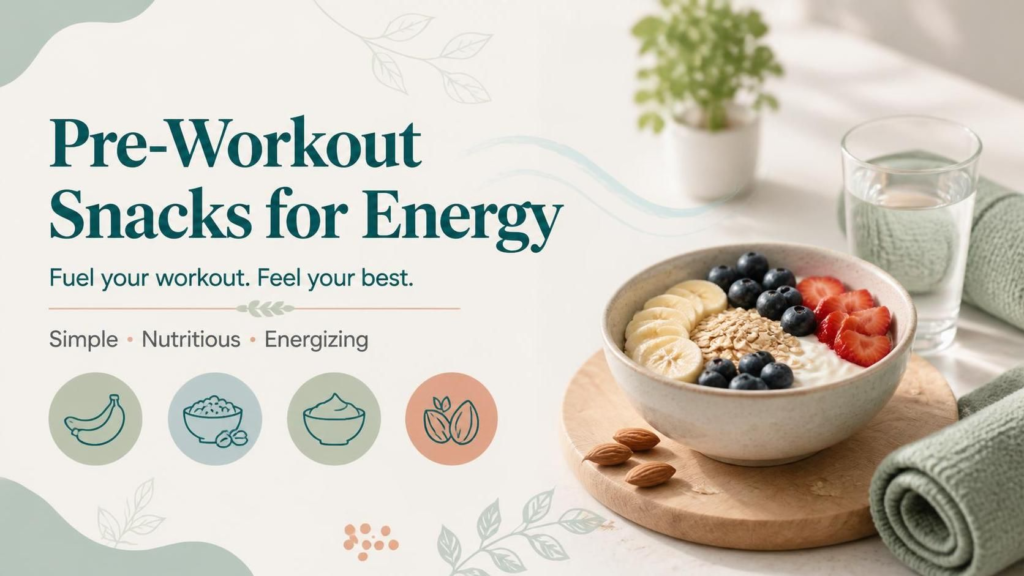
Choosing the right pre-workout snacks for energy can help you feel fueled and comfortable when you exercise, especially if several hours have passed since your last meal. The best pre-workout snack does not need to be complicated. A simple combination of carbohydrate, protein, or both can fit different types of workouts depending on how much time you have before training.
However, not everyone needs a snack before every workout. If you recently ate a balanced meal and feel comfortable exercising, you may not need anything extra. Your ideal pre-workout snacks for energy depend on your workout intensity, duration, hunger level, digestion, and the time available before exercise.
Table of Contents
How Can Pre-Workout Snacks for Energy Support Your Workout?
Your body uses several sources of fuel during exercise, including stored carbohydrate and fat. Carbohydrate becomes particularly important as exercise intensity and duration increase. Research suggests that carbohydrate intake can improve endurance performance, with benefits tending to become more relevant during longer-duration exercise. :contentReference[oaicite:1]{index=1}
This does not mean that every workout requires a high-carbohydrate snack. For a short home workout after a recent meal, eating again may make little difference. For a longer run, cycling session, HIIT workout, or demanding training session after several hours without food, a suitable snack may be more useful.
The goal of pre-workout snacks for energy is therefore not to maximize the amount of food you eat. It is to provide an appropriate amount of fuel while keeping digestion comfortable.
What Makes a Good Pre-Workout Snack?
The best pre-workout snacks for energy share a few practical characteristics. They provide useful nutrients without leaving you feeling excessively full or uncomfortable.
- Carbohydrates: useful as a readily available source of fuel, especially for longer or higher-intensity exercise.
- Protein: can be included as part of a balanced snack, particularly when you have more time before exercising.
- Moderate fat and fiber: these are healthy components of the overall diet, but large amounts immediately before exercise may be uncomfortable for some people.
- Fluids: staying hydrated throughout the day supports normal exercise performance.
- Familiar foods: the best pre-workout snack is one you already know your body tolerates.
Timing matters as well. A larger meal generally requires more digestion time, while a smaller snack can be easier to tolerate closer to exercise. There is no single timing rule that works perfectly for everyone.
10 Best Pre-Workout Snacks for Energy & Endurance
Here are ten practical pre-workout snacks for energy, ranging from quick carbohydrate-rich choices to more substantial combinations for people who have more time before training.
1. Banana
A banana is one of the simplest pre-workout snacks for energy because it provides carbohydrate in a convenient, portable form. It is especially practical when you want something light rather than a full meal.
If you are eating relatively close to exercise, a banana by itself may be easier to tolerate than a heavier snack. When you have more time, you can combine it with a small protein source if that fits your diet and digestion.
Best for: quick fuel before walking, cardio, strength training, or moderate workouts.
2. Toast with Nut Butter
Toast with a small amount of peanut or almond butter provides carbohydrate together with some protein and fat. This makes it more substantial than fruit alone.
Because fat can slow digestion, this option is usually more suitable when you have some time before your workout rather than immediately before intense exercise.
Best for: workouts when you have roughly 1–3 hours to digest your food.
3. Greek Yogurt with Fruit
Greek yogurt provides protein, while fruit supplies carbohydrate. Together, they can make a balanced option among pre-workout snacks for energy when dairy is well tolerated.
Choose a portion that feels comfortable. Eating a large amount immediately before exercise can leave some people feeling heavy or uncomfortable.
Best for: moderate workouts when you have adequate digestion time.
4. Oatmeal with Fruit
Oatmeal can provide carbohydrate along with some protein and fiber. It is more suitable when you have enough time to digest it because a large, fiber-rich serving may feel uncomfortable immediately before intense exercise.
Adding fruit can increase the carbohydrate content and make oatmeal a practical breakfast before a longer training session.
Best for: morning workouts when you have time for a meal before exercising.
5. Rice Cakes with Banana or a Small Amount of Nut Butter
Rice cakes provide a light carbohydrate base that can be paired with fruit or a small amount of nut butter. They are easy to portion, making them flexible pre-workout snacks for energy.
If your workout starts soon, keep the portion modest and avoid adding a large amount of fat.
Best for: people who prefer a light, easily portioned snack.
6. Fruit and Yogurt
Fruit and yogurt provide a combination of carbohydrate and protein. Bananas, berries, peaches, and other fruits can work depending on your preference and tolerance.
If you experience digestive discomfort during exercise, experiment with portion size and timing during ordinary training sessions rather than before an important event.
Best for: moderate training sessions when dairy is comfortable for you.
7. Applesauce with Toast or Crackers
Applesauce can provide an easily consumed source of carbohydrate, while toast or crackers can add additional carbohydrate when you need more fuel.
This combination can be useful when you want pre-workout snacks for energy without eating a large or heavy meal.
Best for: lighter pre-workout eating when you want an easy carbohydrate source.
8. Dates with a Small Protein Source
Dates are naturally rich in carbohydrate and are convenient to carry. A small serving can be paired with yogurt, a few nuts, or another protein source when you have more time before training.
Because dried fruit is concentrated, portion size matters. A small serving may be enough before a shorter workout.
Best for: convenient fuel when portability matters.
9. Whole-Grain Cereal with Milk or a Milk Alternative
A modest bowl of cereal can provide carbohydrate and can be combined with milk or a fortified milk alternative for additional protein and nutrients.
Choose a cereal and portion that you know you tolerate. Very high-fiber cereals or large servings may not be comfortable immediately before intense exercise.
Best for: morning workouts when you have enough time for digestion.
10. A Simple Energy Ball
Homemade energy balls made with ingredients such as dates, oats, nut butter, or seeds can be convenient before exercise. Their nutritional profile varies according to the recipe, so they should be viewed as a flexible food rather than a standardized sports product.
If the recipe contains a large amount of nuts, seeds, or nut butter, it may be better suited to eating farther away from the workout because its higher fat content may slow digestion.
Best for: planned workouts when you want a portable homemade option.
Quick Comparison of Pre-Workout Snacks for Energy
| Snack | Main benefit | When it may fit best |
|---|---|---|
| Banana | Easy carbohydrate source | Close to a workout |
| Toast + nut butter | Carbohydrate with protein and fat | 1–3 hours before |
| Greek yogurt + fruit | Carbohydrate + protein | 1–3 hours before |
| Oatmeal + fruit | More substantial carbohydrate meal | When more digestion time is available |
| Rice cakes + fruit | Light carbohydrate option | Closer to training |
| Fruit + yogurt | Carbohydrate + protein | 1–3 hours before |
| Applesauce + toast | Easy-to-eat carbohydrate | Closer to training |
| Dates + protein source | Portable carbohydrate | Before training |
| Cereal + milk or alternative | Carbohydrate + protein | Morning workouts |
| Energy ball | Portable and customizable | With some digestion time |
These are practical examples rather than strict prescriptions. Portion size, ingredients, workout intensity, duration, and individual tolerance all matter.
How Long Before a Workout Should You Eat?
One of the most common questions about pre-workout snacks for energy is when to eat them. The answer depends mainly on the size and composition of the food.
- Several hours before: a normal balanced meal can provide the foundation for your workout.
- About 1–3 hours before: a moderate snack or smaller meal may work well for many people.
- Less than an hour before: a smaller, relatively easy-to-digest carbohydrate-rich snack may be more comfortable than a large meal.
There is no universal clock that determines the perfect pre-workout meal. A snack that feels comfortable two hours before exercise may feel too heavy 30 minutes beforehand.
Research on pre-exercise nutrition suggests that carbohydrate intake can be particularly useful for longer endurance exercise, while the benefit is less consistent for shorter exercise sessions. :contentReference[oaicite:2]{index=2}
Do You Need Protein in Your Pre-Workout Snacks?
Protein can be part of a pre-workout meal or snack, but it does not need to be forced into every snack. Your overall daily protein intake and dietary pattern are more important than treating a particular snack as a special muscle-building formula.
A systematic review and meta-analysis found that combined carbohydrate and protein intake can have performance benefits in some endurance contexts, particularly around longer recovery periods, but the results depend on the specific conditions and are not a reason to add a fixed amount of protein before every workout. :contentReference[oaicite:3]{index=3}
In practical terms, include a moderate protein source when it fits the meal and when you have enough time to digest it. If your workout starts soon, digestive comfort and an appropriate carbohydrate source may matter more.
Best Pre-Workout Snacks for Energy Before Different Workouts
Pre-Workout Snacks for Energy Before Strength Training
For a typical resistance-training session, you may not need a special snack if you have eaten a balanced meal recently. If several hours have passed and you are hungry, a combination of carbohydrate and some protein can be practical.
Examples include fruit with yogurt, toast with a small amount of nut butter, or a modest cereal-and-milk meal.
Pre-Workout Snacks for Energy Before Running and Longer Cardio
Carbohydrate becomes increasingly relevant as exercise duration increases. A carbohydrate-rich snack may be useful before a longer run, cycling session, or endurance workout, particularly when your last substantial meal was several hours earlier.
Choose familiar foods and pay attention to digestive comfort. Evidence from systematic reviews supports a role for carbohydrate in endurance performance, particularly during longer-duration exercise. :contentReference[oaicite:4]{index=4}
Pre-Workout Snacks for Energy Before Short Home Workouts
A snack may not be necessary before a short home workout if you feel energized and have eaten normally. If you are hungry, something as simple as a banana or a small serving of fruit may be enough.
For ideas on structuring your home training, see our guide to
full-body workouts at home
and our
home workout plans for beginners.
Pre-Workout Snacks for Energy Before HIIT
High-intensity interval training can feel uncomfortable if you eat a large meal immediately beforehand. If you need fuel, a small carbohydrate-rich option may be easier to tolerate than a high-fat or very high-fiber meal.
If you regularly feel unusually tired during HIIT, look beyond food alone. Sleep, hydration, overall energy intake, training volume, and recovery can all influence how you feel during exercise.
What Are the Best Pre-Workout Snacks for Energy in the Morning?
You do not automatically need to eat because it is morning. Some people are comfortable exercising after waking without food, while others feel better after a small snack.
If you wake up hungry or are preparing for a longer or demanding session, a simple carbohydrate-rich food such as a banana, toast, or applesauce may be practical. If you have more time before training, you can choose a more substantial breakfast.
For more ideas, see our guides to
energy-boosting breakfast foods
and
high-protein breakfast ideas for energy.
Can Pre-Workout Snacks for Energy Support Fat Loss?
Eating a pre-workout snack does not automatically prevent fat loss. Changes in body weight are influenced by overall energy intake and expenditure over time, not simply by whether you eat immediately before exercise.
At the same time, you do not need to add a snack simply because you are exercising. If you are not hungry and have recently eaten, an additional snack may provide little practical benefit.
A better question is whether the food helps you train comfortably and fits your overall eating pattern.
Foods to Limit Immediately Before Exercise
There is no universal list of forbidden foods, but some choices are more likely to cause discomfort when eaten shortly before intense exercise.
- Very large meals
- Very high-fat meals immediately before training
- Very high-fiber portions immediately before intense exercise
- Foods you already know cause bloating or stomach discomfort
- Large amounts of unfamiliar foods before an important workout or competition
Fat and fiber are not unhealthy foods to avoid altogether. The issue is often timing and individual tolerance. A food that works well several hours before exercise may feel uncomfortable when eaten immediately beforehand.
Common Myths About Pre-Workout Snacks for Energy
Myth 1: Everyone Needs a Pre-Workout Snack
Not necessarily. If you have eaten an adequate meal and feel comfortable, you may be able to train without an additional snack.
Myth 2: More Food Means More Workout Energy
More food is not automatically better. A large meal immediately before exercise can make you feel heavy or uncomfortable. The goal is appropriate fuel, not maximum food intake.
Myth 3: Protein Is the Most Important Pre-Workout Nutrient
Protein has an important role in the overall diet, but pre-workout nutrition should not be reduced to protein alone. For many endurance-oriented sessions, carbohydrate availability is particularly relevant.
Myth 4: You Must Eat at Exactly the Same Time Before Every Workout
Your ideal timing can change depending on the meal, workout intensity, duration, and digestive tolerance. Use timing as a flexible framework rather than a rigid rule.
How to Build Your Own Pre-Workout Snack
Instead of memorizing one perfect snack, use this simple decision process:
- Check when you last ate. If you recently had a balanced meal, you may not need another snack.
- Check the workout. Longer and more demanding sessions generally make carbohydrate availability more relevant.
- Check the time. The closer you are to exercise, the smaller and easier to digest your food should usually be.
- Check your stomach. Choose foods you know you tolerate.
- Adjust through experience. Notice what you eat, when you eat it, and how you feel during training.
This approach is more useful than following a rigid list of grams or minutes that may not fit your individual needs.
Simple Pre-Workout Snack Combinations
| Situation | Possible option |
|---|---|
| Workout starts soon | Banana or applesauce |
| About 1–2 hours before | Fruit + yogurt |
| More time available | Toast + nut butter + fruit |
| Morning workout | Oatmeal + fruit or cereal + milk/alternative |
| Longer endurance session | A familiar carbohydrate-rich meal or snack |
These combinations are examples rather than individualized nutrition prescriptions. Portion sizes should match your appetite, activity level, workout demands, and overall eating pattern.
Watch: 10 Best Pre-Workout Snacks for Energy
Prefer a quick visual overview? Watch the video for a simple breakdown of ten practical pre-workout snacks for energy and when each option may fit best.
Key Takeaways
- Pre-workout snacks for energy can be useful when you are hungry, have not eaten for several hours, or are preparing for a demanding or prolonged workout.
- Carbohydrates are particularly relevant for longer or higher-intensity endurance exercise.
- A snack is not mandatory before every workout.
- The closer you are to exercise, the more important portion size and digestive comfort become.
- Protein can be part of a pre-workout meal, but there is no universal need to add a fixed amount before every workout.
- Choose familiar foods and test your timing during normal training rather than before an important event.
Frequently Asked Questions
What are the best pre-workout snacks for energy if I train early in the morning?
If you feel hungry before an early workout, a small, easy-to-digest carbohydrate-rich option such as a banana, toast, or applesauce can be practical. If you are training for longer or at higher intensity, you may prefer a more substantial breakfast when you have enough time to digest it.
Can I eat pre-workout snacks for energy if I want to lose fat?
Yes. Eating before exercise does not automatically prevent fat loss. Your overall dietary pattern and energy balance over time matter more. If you are not hungry and recently ate, however, you may not need an additional snack.
How long before a workout should I eat pre-workout snacks for energy?
Timing varies according to the size and composition of the food. A larger meal generally needs more time than a small snack. A practical approach is to eat a normal meal several hours before training when possible, or choose a smaller, easier-to-digest snack when exercise is closer.
Are pre-workout snacks important for morning workouts?
Not for everyone. Some people are comfortable exercising after waking without eating, while others perform or feel better after a small snack. Your workout duration, intensity, hunger, and personal tolerance should guide the decision.
What should I avoid eating before a workout?
Avoid foods that you know cause digestive discomfort, particularly large portions of very fatty or very high-fiber foods immediately before intense exercise. There is no universal list of foods that everyone must avoid.
Can pre-workout snacks improve focus and endurance?
They can help when inadequate food intake or hunger is limiting your ability to train comfortably. Carbohydrate availability is particularly relevant to longer endurance exercise, but the effect is not the same for every workout or every person. :contentReference[oaicite:5]{index=5}
Final Thoughts on Pre-Workout Snacks for Energy
The best pre-workout snacks for energy are not necessarily the most complicated ones. They are the foods that provide appropriate fuel for your workout, fit the time you have available, and feel comfortable in your stomach.
Start with the basics: consider when you last ate, how demanding the workout will be, and how much time you have before exercise. From there, choose a familiar carbohydrate-rich food or a balanced snack when appropriate.
If you want to build your overall energy habits beyond pre-workout nutrition, explore our guide to
daily healthy habits that can support natural energy
and our article on
foods that can support energy and stamina.
And remember: nutrition is only one part of workout performance. Sleep, hydration, recovery, training load, and consistency all contribute to how you feel and perform.
Selected Scientific References
Ramos-Campo DJ, et al. The ergogenic effects of acute carbohydrate feeding on endurance performance: a systematic review, meta-analysis and meta-regression.
PubMed
Reynolds KM, et al. A Food First Approach to Carbohydrate Supplementation in Endurance Exercise: A Systematic Review.
PubMed
Rothschild JA, Kilding AE, Plews DJ. What Should I Eat before Exercise? Pre-Exercise Nutrition and the Response to Endurance Exercise.
PubMed
Beelen M, et al. The Effect of Ingesting Carbohydrate and Proteins on Athletic Performance.
PubMed
American College of Sports Medicine. ACSM Position Stands.
ACSM
Important: This article provides general nutrition information and is not individualized medical or dietary advice. If you have a medical condition, take medication that affects blood glucose, or have specific dietary restrictions, consult an appropriately qualified healthcare professional for individualized guidance.
About The Author


